Broomfield: The Physics Hiding in a 1948 Grain Silo
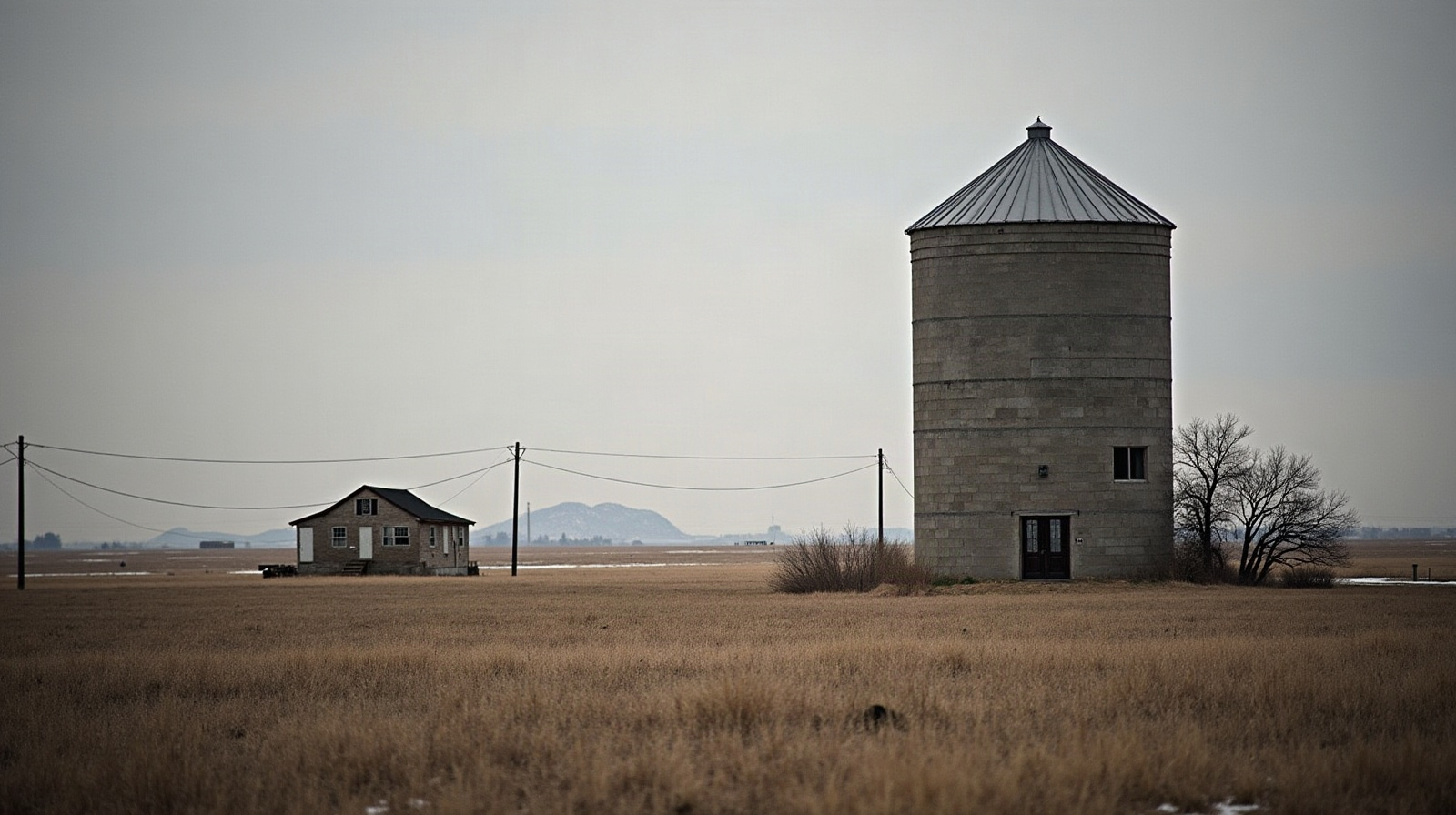
There is a concrete cylinder standing on a 3.16 acre patch of city owned land at 1790 West 160th Avenue, and this month it might become an official Broomfield landmark. It is the last structure left from the old Nordstrom Ranch, built around 1948, and it has spent nearly eight decades doing something that sounds simple but is actually a small triumph of applied physics: holding up a pile of loose grain without falling down.
That sounds like faint praise. It is not. Grain silos fail more often than people assume, and the reason this one has not is worth a closer look, because it says something about how engineers learned to work with one of the more unruly materials on Earth: bulk granular solids. Wheat, corn, sand, gravel. Stuff that is not quite a liquid and not quite a solid.
Here is the puzzle silo builders faced. If you fill a tank with water, the pressure on the walls rises steadily with depth, according to a clean, predictable rule every plumbing engineer knows by heart. Grain does not obey that rule. Around 1895, a German engineer named H. A. Janssen noticed that pressure on the walls of a grain bin rises with depth only up to a point, then levels off. The reason is friction. As grain settles, individual kernels wedge against their neighbors and against the walls, and much of the weight above gets transferred sideways and carried by wall friction rather than pushing straight down to the bottom. It is a bit like a traffic jam holding itself up: cars are heavy, but once they are packed and stopped, the load transfers through contact points rather than crushing the road evenly.
This “Janssen effect” is why silo walls do not need to get thicker and thicker toward the bottom the way a dam does. But it creates its own problem, because that sideways push, called hoop stress, wants to bulge the walls outward, and it wants to do so unevenly if the container has corners. Corners are where granular materials jam, arch, and then suddenly release, sometimes violently, in what engineers call a collapse or an avalanche event. A rectangular grain bin has to fight this tendency at every seam. A cylinder does not. Round walls spread hoop stress evenly around the whole circumference, with no weak points for the grain to concentrate force against. That is the entire reason silos are round: not tradition, not aesthetics, but a structural shortcut that lets a thin concrete or corrugated steel shell resist enormous internal pressure using very little material.
The Nordstrom Ranch silo, built at the tail end of Broomfield's dryland and irrigated farming era, is a modest example of a design principle used everywhere from Kansas grain elevators to the fuel silos at rocket launch pads. Whoever poured its walls in 1948 was not thinking about Janssen's equations. They were almost certainly working from decades of accumulated trade knowledge, the kind that gets passed from one barn raising to the next without anyone writing down the underlying math. But the physics was doing its work regardless, the same way it does in an anthill or a sand dune. The structure survives not because concrete is stubborn, though it helps, but because its shape quietly resolves a mechanical argument between gravity, friction, and geometry.
Landmark status, if the council grants it, would protect the silo from demolition and commit the city to some level of upkeep. That is a policy question, not a scientific one, and reasonable people can disagree about how much civic effort should go toward preserving a single agricultural outbuilding. But it is worth pausing, before the vote, to notice that the structure up for a preservation vote is also a small monument to a problem humans have been solving since the first farmers learned to store more grain than they could eat in a season: how do you keep a pile of loose material from doing whatever it wants. The answer, it turns out, is to give it no corners to argue with.